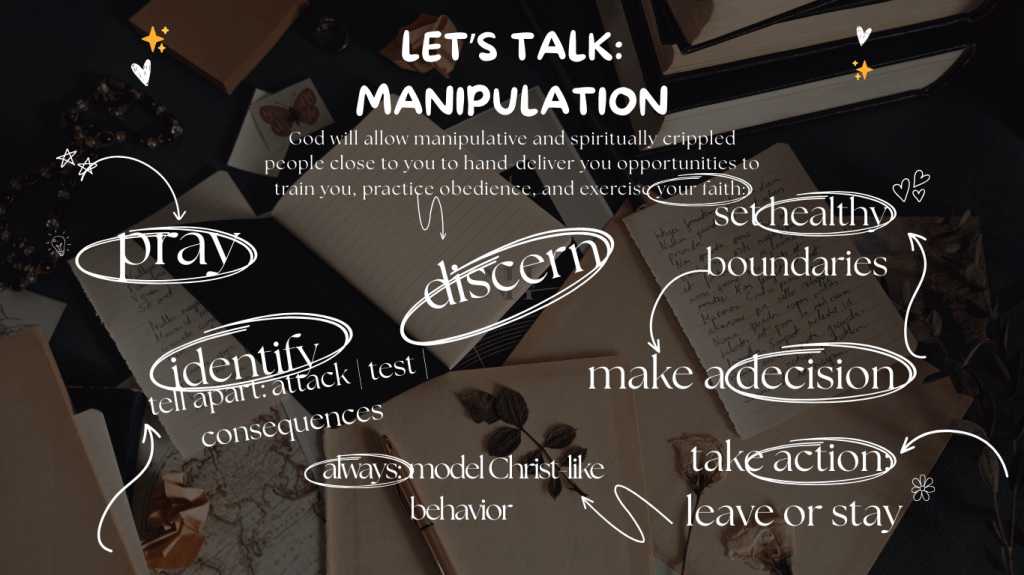
We don’t want to learn how to manipule from them. That’s not what I mean at all. What I’m trying to say here is that, God Can Use Difficult People to Train Us.
Most of us pray for growth and patience, but we don’t necessarily expect difficult people or relationships to be the source where growth will actually come from. We imagine God shaping us through peaceful moments, answered prayers, or encouraging voices. Often, God allows manipulative, immature, or spiritually unhealthy people close enough to build us up, those individuals have the ability to expose us, and ultimately if we don’t let them define us—God can refine us through those experiences.
Those manipulative people become unintentional instructors; I see it as hand-delivered opportunities to learn, be obedience, develop discernment, practice boundaries, and grow in spiritual maturity.
Manipulative behavior doesn’t feel very holy at all, and it is because it’s not. But God can still use it for holiness.
Below is a simple, practical, and spiritually grounded process for handling manipulation without losing your peace or your character.
What can one do when dealing with manipulative and generally difficult people:
1. Pray: We want to invite God into the moment or situation before we react. Manipulation is designed to provoke a reaction. We want to be able to respond with grace.
WebMD says that to manipulate someone is: “To dishonestly control or influence someone’s thoughts, feelings, or actions for personal gain, usually by exploiting their weaknesses. It is a form of social influence that disregards the victim’s best interests, often using tactics like guilt, lying, gaslighting, or isolation to gain power.”
Here are Common Signs and Tactics of Manipulation
- Gaslighting: Making one question their own reality, memory, or sanity.
- Guilt-tripping & Victim Playing: Making a person feel responsible for their actions or turning themselves into the victim to avoid accountability.
- Silent Treatment: Withholding communication to punish or control a person.
- Love Bombing: Showering with excessive affection early on to create unhealthy dependency.
- Moving the Goalposts: Changing expectations so the other person can never satisfy them.
- Isolation: Distancing someone from friends and family to increase dependency.
Pausing to pray can interrupt those pattern. We want to pray to regain spiritual alignment before engaging the situation. Prayer helps slow the nervous system, calms emotional reactivity, and creates space for the Holy Spirit to orient ones thinking.
A 15-second prayer can reset the entire interaction:
“Lord, thank you for guidance, help me see clearly and respond in your truth, don’t let me be lead by my own emotions.”
2. Discern What’s Really Happening
Not every uncomfortable moment is manipulation. We don’t want to accidentally call a disagreement gaslighting or manipulation. Sometimes it’s a misunderstanding, immaturity, or even a mirror revealing our own blind spots.
Studies have demonstrated that stepping back moves one from emotional mode to analytical mode, where clarity can be form.
Ask yourself:
Is this truly manipulation or just poor communication? Is there a pattern? Is something in me being triggered? What is the motive, or spirit behind this/their behavior?
Discernment is more than noticing behavior; it’s clarity to notice reality.
3. Determine the Category: Attack, Test, or Consequence
What’s the level? Think of it this way—Clarity creates wisdom. Wisdom creates peace. Peace creates better decisions.
Every difficult interaction generally falls into one of three categories:
An Attack
When the enemy is trying to guilt, pressure, control, or harm us. These attacks often manifest as temptations, lies, depression, or sudden crises during times of vulnerability, fatigue, or just before a major breakthrough. This requires boundaries, distance, and protection.
Test
A situation God uses to grow patience, maturity, courage, or emotional strength. Tests are not punishments, tests are like a training.
Consequence
Sometimes dealing with difficult people and manipulation is the natural result of our own choices. Consequences are not to be fought against but learned from. We messed up? We fox it.
Identifying the category changes posture.
4. Set Healthy Boundaries
Boundaries are not punishment; to you or others, they are more like property lines.
They communicate:
What you will allow (from your part or other’s), what you won’t allow, and what happens if a boundary is ignored.
Psychology puts it this way, boundaries protect emotional and psychological spaces.
In Scripture we see that, boundaries help protect spiritual integrity.
Boundary-setting is one of the ways we honor God with our choices in life.
5. Decide: Choose Your Course of action with sobriety and courage. Indecision can keep a person stuck in an emotional fog.
Clarity gives freedom.
After praying, discerning, and identifying what you’re dealing with, the next step is making a decision. Sometimes the decision making part is small, like what to say next. But this is huge, because it reshapes the relationship entirely.
God honors decisive obedience.
6. Take Action: Faith Requires Movement. Once we know what to do, we must do it.
Follow through with what our spirit and wisdom agreed upon.
Our actions may be:
Addressing the behavior. Communicating a boundary Limiting access. Seeking counsel or, when necessary, stepping away completely. Regardless if this is a personal, social, or professional relationship—we can still use these steps.
Faith is moving.
7. Model Christ-Like Character
No matter what one decides, our character is the part God is developing. We may not see it now, but we will.
One can walk away from manipulation without becoming manipulative.
These steps have helped people become aware of their own behaviors and how being in close relationships with manipulative people has affected them. Many times they are able to realize that they might be crossing the line into being manipulative themselves.
A person can set boundaries without becoming bitter and speak truth without losing love.
Growth happens when we respond to dysfunction with spiritual maturity.
Final Encouragement
Manipulative people don’t have to derail your spiritual journey, they can refine it. Every encounter becomes a moment to train your discernment, strengthen your boundaries, and deepen your reliance on God.
Let difficult people be your teachers, but let God be your Master Instructor.
“Be wise as serpents and innocent as doves.” — Matthew 10:16
Thank you for reading and being part of this journey.
Schedule your mental health and life coaching appointment today.
©️2026 New Hope MHCLC Assoc. All rights reserved.

Leave a comment