The heart of a wife is akin to the home of a mother—a sanctuary built on love, care, and vigilance. As wives, we love fiercely and without condition. We care deeply, seeing dangers on the horizon like an eagle surveying its surroundings. We warn, we shield, and we nurture—not out of obligation but from an innate, God-given calling to protect and preserve.
Just as a mother watches over her children, so does a wife tend to her marriage. When our children are young, our love knows no limits, unaffected by tantrums or rejection. We pour into them, nurture their spirits, and guide them through the storms of childhood. When they grow older, and the distance grows, our love adapts. We pray in silence, we watch from afar, and we stand ready to guide when they seek us.
So it is with the heart of a good wife even after becoming an ex-wife—a heart that continues to care despite betrayal, pain, or distance. Even when the marriage is broken, the desire for peace and wholeness lingers. It’s a love that looks beyond lies, mistreatment, and misunderstandings. It holds onto hope—not for personal gain but for the well-being of someone you once vowed to love forever.
This kind of love is not unique to one person; it’s a reflection of the sacrificial love seen in countless stories throughout history, scripture, and life.
In Hosea, God commanded the prophet to love his unfaithful wife, Gomer, as a symbol of God’s unrelenting love for His people. Hosea’s love was not dependent on Gomer’s actions but on his commitment to God’s calling and a deeper understanding of grace.
There are films like The Story of Us or Marriage Story that show us the complexities of love that lingers even after a relationship ends. They reveal the ache of wanting peace and healing despite the fractures in the relationship.
Many real-life stories reveal how ex-wives and ex-husbands, despite their differences, continue to care for one another—whether through co-parenting, emotional support, or prayer. These stories remind us that love, when true, transcends circumstances.
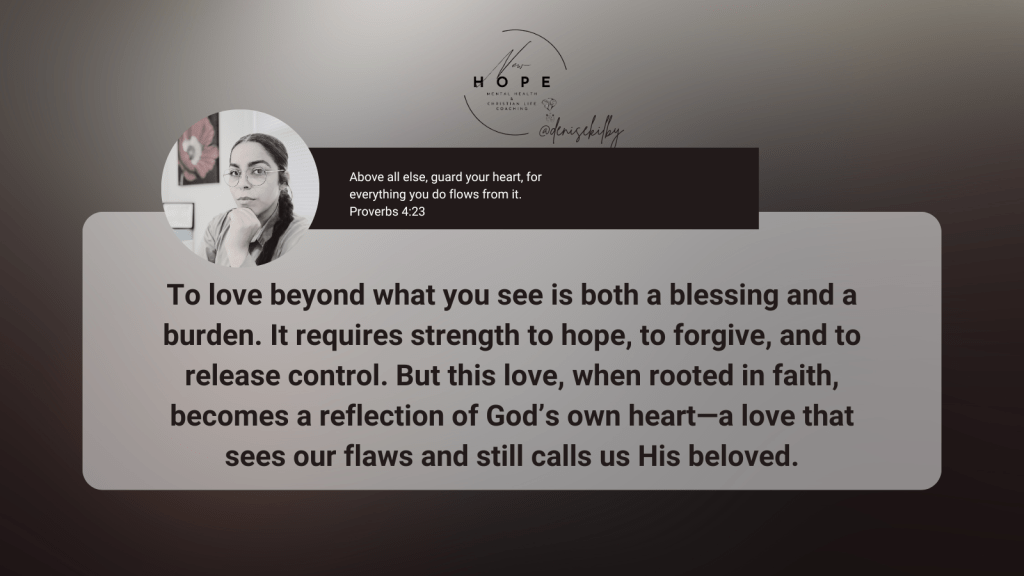
To love beyond what you see is both a blessing and a burden. It requires strength to hope, to forgive, and to release control. But this love, when rooted in faith, becomes a reflection of God’s own heart—a love that sees our flaws and still calls us His beloved.
Many times I sit in silence reflecting on my own journey. I find myself caught between love and reality. My ex-husband, a man I once vowed to walk with forever, remains in my heart. There is a part of me that yearns for closeness, for family, for the warmth of reconciliation. And yet, reality reminds me that his actions do not align with the love and respect a marriage should embody. So why do I still care? Why does my heart refuse to harden?
I believe it’s God.
A Heart Shielded by Grace
At times, I wonder if I should be angry—if I should let resentment take root and build walls to protect myself. But it’s as though God won’t allow it. He guards my heart, not to excuse the wrongs done to me but to keep me from being consumed by bitterness. I am reminded of Proverbs 4:23:
“Above all else, guard your heart, for everything you do flows from it.”
To hold onto anger would mean poisoning the wellspring of my life. It would alter not just how I feel about him but how I love others, how I see myself, and how I connect with God.
Loving Beyond the Pain
This isn’t about ignoring the hurt or pretending everything is fine. I know the lies, the cheating, the empty promises, or even more recently the lack of effort. But God whispers to me that love, real love, is not about tallying offenses. It’s about seeing someone through the lens of grace. It’s about recognizing that their actions don’t define who I am or dictate the boundaries of my love.
There’s a story in the Bible that resonates deeply with me—the story of Jesus washing Judas’s feet. Knowing Judas would betray Him, Jesus still chose to serve him with humility and love. It wasn’t about condoning Judas’s betrayal but about showing that love is not transactional. It doesn’t stop when it’s rejected or when it’s inconvenient.
A Process of Transformation
I’m beginning to understand that this love I feel is not just about him. It’s about what God is doing in me.
- He’s teaching me to release control, to let go of the desire to fix what’s broken.
- He’s showing me that love is not always about reconciliation but sometimes about prayerful intercession.
- He’s molding me into someone who can love without being defined by another’s response.
This process isn’t easy. There are days when I wrestle with my desires, wishing for a different outcome, longing for a family restored. But I am learning that love doesn’t always mean proximity. Sometimes the most profound love is the kind that releases someone into God’s hands while holding them in your prayers.
Living in the Tension
If you’re walking a similar path, know that you are not alone. Loving someone who has hurt you is one of the hardest things you can do. It requires strength, humility, and faith in God’s greater plan.
You don’t have to justify your love or explain your heart. Let God lead you through this process, trusting that He sees your pain and honors your efforts to remain kind and faithful. In time, He will reveal the purpose behind your journey and the beauty that can come from loving beyond yourself.
For now, I hold onto this truth:
“Love is patient, love is kind. It does not envy, it does not boast, it is not proud. It does not dishonor others, it is not self-seeking, it is not easily angered, it keeps no record of wrongs.” (1 Corinthians 13:4-5)
Even from a distance, love can be a force for healing, growth, and peace. The heart of a wife—even when wounded—loves forever. And I wonder, is there something truly special about marriage? Something divinely orchestrated that binds two souls together so deeply that no man should ever attempt to separate it?

Leave a comment